
Tip: Start typing in the input box for immediate search results from our Support Resources Knowledge Base.
For a more comprehensive search, use the site search in the main menu above.
How to decide which EEG electrode technology best fits your research

by Laura Leuchs, PhD, Sara Pizzamigilo, PhD and Eduardo Bellomo, PhD
Scientific Consultants (Brain Products)
You would like to start with EEG research, but you are unsure what type of electrode technology works best for you? Maybe you have heard about active, passive, gel-based, dry, or sponge-based electrodes, but you don’t have a clear picture of the different options and their properties?
Given the range of possibilities, it can be hard to choose the best EEG system for your research. If you could use some guidance, this article is a good start for you.
For tips on “How to decide which EEG amplifier best fits your research” click here.
Introduction
Each EEG research project comes with specific challenges. At Brain Products, we strive to meet the highly specific needs of EEG researchers and are proud to offer a variety of electrode systems for a wide range of applications.
To start with, there are a few fundamental questions you may want to consider before deciding which electrode system is right for you:
- What is your ideal balance between signal quality, speed of preparation and participant comfort?
- Will you be conducting highly controlled stationary research in the lab, or are you looking for a versatile mobile setup to take your research into dynamic real-life settings?
- What population (healthy adults, children, patients, etc.) will you be testing with?
- Do you need high-density coverage or just a few EEG channels for your measurements?
- How long are your experiments?
- Are you planning to combine EEG with other techniques such as fMRI, TMS, fNIRS?
Depending on your answers, one or another solution might work best for you. In the first part of this article, we will briefly introduce the concept of electrode impedance and the differences between available technologies. In the second part, we will address some factors that could guide your decision towards the optimal electrode technology for your specific experiments.
1. The technological features of EEG electrodes
1.1. Is good signal quality all about electrode impedance?
When setting up your EEG measurement, there is one word you will unavoidably come across: impedance. Electrical impedance (measured in Ohms, Ω) is a measure of how easily charged particles (i.e., current) can pass through a substance. To make this as easy as possible on the electrode side, the head of every electrode is coated in materials like Ag/AgCl or gold.
A large part of setting up an EEG measurement gravitates around reducing the impedance – thereby facilitating the current flow – between electrode head and scalp. The lower this electrode impedance, the more the EEG data will reflect electrical signals stemming from brain activity underneath the scalp, and the less it will be affected by other confounding electrical signals (e.g., line noise). Lower electrode impedance thus ensures a higher “signal-to-noise ratio” and consequently better data quality.
But what electrode impedance levels are needed to achieve good signal quality?
EEG guidelines for traditional (passive gel-based) electrode systems recommend reducing impedances down to a very low level of ~5 – 10 kΩ (e.g., Luck, 2005). Such low impedance values usually ensure optimal data quality, but they can only be achieved by abrading the skin and applying conductive gel. This practice, in turn, can come with disadvantages such as long preparation times and inconvenience or even discomfort for the participant.
Alternative solutions to the traditional approach offer a compromise: some electrode systems allow working at higher impedance levels, which save preparation time and effort and can improve the comfort for the participant. To compensate for the higher impedance values while still ensuring good data quality, such electrode systems can employ additional strategies such as:
- Using “active” instead of “passive” electrode technology (see below)
- Electrically shielding the EEG electrode heads or cables
- Restricting cable movement (e.g., by routing the cables on the cap)
The impedance between electrode and scalp is therefore important, but it is not the only factor determining the EEG signal quality.
Tip: There are additional strategies to improve the signal-to-noise ratio (SNR) of your data which are independent of the electrode technology. Examples are:
- Working in an electrically shielded environment (e.g., inside a Faraday cage)
- Using EEG amplifiers with high “input impedance” (see this article on amplifier technology and this webinar session)
- Recording more data, in terms of trials or participants (to average out unsystematic noise)
- Removing or attenuating noise with offline processing (learn more in this webinar on artifact handling)
1.2. Active vs passive electrode technology – what is the difference?
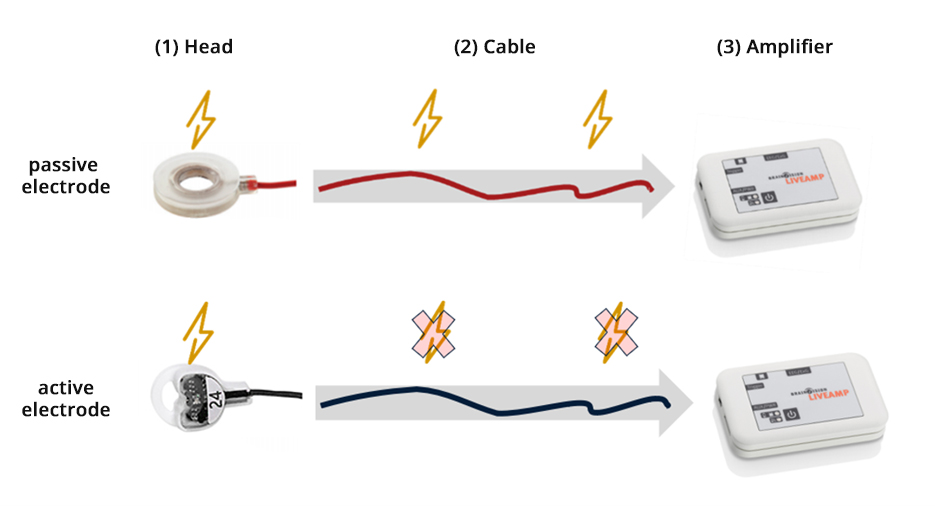
As mentioned above, active electrode technology is often used to achieve good signal quality even at higher impedance values. To better understand this concept, we can think of an EEG electrode (including the whole length of its cable) as an antenna detecting any kind of electromagnetic activity. The EEG signal can therefore be intermixed with electromagnetic and kinetic noise affecting the electrode head (1) and the cable (2) before it reaches the EEG amplifier (3) where the signal is finally converted and amplified (see Figure 1).
While this is true for traditional passive electrodes, active electrodes are equipped with a small electronic circuitry that performs an impedance conversion directly at the scalp. The impedance converter inside each electrode guarantees a high-quality EEG signal independent of extraneous noise and/or movements affecting the electrode cables (see also “The principle of impedance conversion” in our actiCHamp (Plus) Operating Instructions). The “antenna effect” is thus limited to the electrode head (1). This impedance conversion is the reason why active electrode technology is more robust against cable motion and noisier environments, and it can partially compensate for higher electrode impedance values.
1.3. Scalp-to-electrode contact: gel, sponges, or dry electrodes
In this section, we will explore different approaches to obtaining adequate scalp-to-electrode contact and which solutions Brain Products offers for each one of them (see Figure 2).

1.3.1. Gel-based electrode technology
The principle behind this technology is bridging the gap between electrode pin and scalp with conductive electrolyte gel. This method achieves the cleanest possible signal and highest data quality. The gel ensures stable scalp-to-electrode contact that can be maintained for a long time, making this the recommended approach for EEG experiments that involve large movements or long measurement durations.
Passive gel-based electrode systems, like our BrainCaps or the LiveCap for the mobile LiveAmp amplifier, work with ring-shaped electrodes called “Multitrodes”. They have a long-lasting tradition, and many labs still consider them the gold standard. They work optimally at a very low impedance levels (~5 – 10 kΩ), reached by moderately rubbing the skin underneath the electrodes with abrasive gel.
Active gel-based electrodes, like our actiCAP slim/snap, work optimally even at higher impedance levels (25 – 50 kΩ) thanks to their active technology, which can save time on electrode preparation.
Tip: For a comparison of active and passive gel-based systems at different impedance levels take a look at Laszlo and colleagues (2014) and Mathewson and colleagues (2017).
1.3.2. Sponge-based electrode technology
Sponge-based systems, like our R-Net, work with passive electrodes that are embedded in a flexible silicone net and make contact with the scalp via small wet sponges. Instead of preparing the electrodes one by one with gel, the whole net is soaked for 10 minutes in a saline solution (KCl) before the participant arrives and is then ready to be applied.
With this technology, due to the different type of electrode-to-scalp contact, you should aim at impedance values of 60 – 100 kΩ, which are higher compared to gel-based systems. Nevertheless, you can expect good signal quality for investigating event-related potentials (ERPs) and frequencies up to 100 Hz, for recording durations of typically 60 to 90 minutes. This procedure reduces preparation time drastically in comparison to gel-based systems. Because no skin abrasion, syringes, gel, or pressure on the scalp are involved, this is considered the most comfortable EEG system for participants.
Tip: Watch these videos for complete tutorials on how to set up R-Net and actiCAP slim/snap.
1.3.3. Dry electrode technology
Dry electrodes are entirely gel-/saline-free and contact the scalp directly by exerting the right amount of mechanical pressure. The greatest advantages of this technology are the fast setup and absence of gel residuals. Since the conductivity is not supported or stabilized by any electrolyte, impedance levels of dry electrode systems remain high: you should aim for impedance values under 2,500 kΩ, but typically you can reach around 300 kΩ for your measurements.
With dry electrode technology, additional strategies are vital to ensure good signal quality. Therefore, both of our dry electrode systems, the CGX Quick systems and our actiCAP Xpress Twist work with active electrode technology. Notably, differently from other dry electrodes systems, each sensor of the CGX Quick systems is additionally electrically shielded from external noise.
Because dry electrodes need to apply a certain amount of pressure on the scalp, they are recommended for shorter-length experiments to avoid discomfort for the participant. The actiCAP Xpress Twist is recommended for measurements of max. 30 minutes, while the CGX Quick systems offer comfort for longer measurements (~60 minutes), thanks to their patented spider-shaped Flex sensors which distribute the pressure on the scalp.
With dry electrode technology, you can expect good signal quality for most studies investigating ERPs and frequencies in a low range (i.e., with actiCAP Xpress Twist: 1 – 35 Hz; with CGX Quick systems: 0.5 – 45 Hz).
Tip: For an overview of available cap types and sizes for different electrode technologies, please take a look at this article.
2. Which factors are important for choosing your electrode system?
We have now introduced several important concepts: electrode impedance, the difference between active and passive electrode technology, and different approaches to establishing contact between electrode and scalp. These principles are strongly inter-connected and choosing your electrode system may mean finding the right balance between signal quality, invested effort and the participant’s comfort.
In this section, we will look at important factors specific to your research project that may determine which electrode system works best for you. Hopefully, these considerations will help to guide you towards the best possible solution for your research.
Table: Characteristics of different Brain Products electrode systems
| actiCAP slim/snap | BrainCap / LiveCap | R-Net (MR) | CGX Quick | actiCAP Xpress Twist | |
|---|---|---|---|---|---|
| Technology | active gel | passive gel | passive saltwater-sponge | active dry | active dry |
| Target impedance | 25 kΩ | 5 – 10 kΩ | 60 – 100 kΩ | < 2,500 kΩ | < 500 kΩ |
| Recommended bandwidth | limited by amplifier | limited by amplifier | DC – 100 Hz | 0.5 – 45 Hz | 1 – 35 Hz |
| Max. channels | up to 160 (64 mobile) | up to 256 (LiveCap up to 64 mobile) | up to 160 (64 mobile) | up to 32 (32 mobile) | up to 32 (32 mobile) |
| Preparation time | ~5 – 10 min. for 32 channels | ~25 min. for 32 channels | < 5 min. for 32 channels | < 5 min. for 32 channels | < 5 min. for 32 channels |
| Recording duration | up to 12h | up to 12h | 60 – 90 min. | 30 – 60 min. | 15 – 30 min. |
| Post-recording residuals | gel | abrasive gel | slightly moist hair | no residuals | no residuals |
| Comfort for participant* | high | good | very high | good | medium |
| Robustness to motion artifacts | very high | high | medium | medium | low |
| Possible simultaneous recordings | TMS, fNIRS, tACS | BrainCap only: TMS, fNIRS, fMRI MEG, tDCS, tACS | fMRI | ||
| Flexibility for multiple head sizes** | exchangeable cap sizes (infants to adults) | fixed cap size (infants to adults) | fixed cap size (neonates to adults) | Fits head sizes 52 – 62 | exchangeable cap sizes (infants to adults) |
* Comfort during both preparation and measurement.
** Cap sizes can be exchanged flexibly for the same electrode bundle if the electrodes are snapped into holders on the cap. This is not the case if the electrodes are permanently fixed to the cap.
2.1. The goal of your EEG analysis: what do you want to measure?
Will you investigate classical ERPs? Are you interested in frequency analysis in a particular bandwidth or would you like to explore specific oscillations? Depending on your research goal and the strength of the signal of interest, you might favor a system that provides either highest data quality, more comfort, or fast preparation time.
2.1.1. Simple analysis goals
If the phenomenon you are investigating is large and unmistakable, then any of the above-mentioned technologies might serve your purpose. If you are, for example, looking for a typically strong component in your ERP study (e.g., a visually evoked potential or the P300 component), then you will not need to worry too much about noise contaminating your signal. In this case, you could opt for a system with a particularly quick setup, for example using dry electrodes like the CGX Quick or actiCAP Xpress Twist. Also, a sponge-based solution like the R-Net can be a great choice.
2.1.2. Complex analysis goals
Smaller ERP components, or other more subtle phenomena instead require high signal quality to be detectable. If you would for example like to run time-frequency analyses focusing on gamma or delta bands, consider that both high and low EEG frequencies are more easily contaminated by noise. In this case, you may prefer electrode technology that ensures the highest signal quality and therefore opt for gel-based systems like actiCAP slim/snap, BrainCap or LiveCap. These (particularly the active electrodes) are most robust to extraneous noise. Alternatively, the sponge-based R-Net may also be a good option for frequencies up to 100 Hz, provided your study does not involve too much movement.
2.2. Experimental population
When working with healthy adults, you are free to choose any solution, depending on whether you favor signal quality, fast setup, mobility etc. However, with more sensitive experimental populations like children, infants, or patients that cannot stay still for too long, the participant’s experience might affect compliance to the experiment and, indirectly, data quality. Our R-Net is ideal when working with these populations: it minimizes discomfort (i.e., no skin abrasion, syringes, mechanical pressure, or gel residuals in the hair) and reduces preparation times which avoids fatigue. It provides the right balance between good signal quality and a convenient setup for both the experimenter and participant.
For other populations (e.g., businesspeople, students), it might be decisive to have ready-to-wear, gel-free solutions with short preparation times. For recordings in real-life settings like schools, working environments, or public spaces, but also in the fields of neurofeedback, BCI, or neuromarketing, our active dry electrodes systems like the CGX Quick systems or the actiCAP Xpress Twist may suit your experiments perfectly. If slightly damp hair is acceptable, then the R-Net can also be considered.
Tip: Find some useful tips in this article how to best record the EEG of participants with thick natural hair.
2.3. Duration of your experiment
EEG measurement durations can vary greatly depending on the application: traditional ERP tasks usually last 20-30 minutes while sleep studies may span a whole night. In addition to the actual measurement duration, you should also consider the time required for preparation, and clean-up. Let us look at which electrode technologies are optimal for which durations:
2.3.1. Short experiment duration (30 – 45 minutes)
In this case, you might want to consider a system with minimal preparation time such as active-dry or sponge-based electrodes. Both technologies offer extremely fast setup and minimal cleaning time while still ensuring good signal quality. With these systems, you can fit several recordings into your data collection schedule with minimal effort from both researcher and participant.
Tip: Watch this video tutorial how to set up the active dry CGX Quick headset.
2.3.2. Medium experiment duration (60 – 90 minutes)
This is the most typical timeframe for EEG experiments. Depending on factors like comfort, requirements on data quality, mobility, etc., we would either recommend the R-Net or the actiCAP slim/snap.
The R-Net allows a very quick setup and cleaning, but keep in mind that its sponges will start drying after a while (~60 – 90 minutes, depending on environment humidity and temperature) which lowers the electrode-to-scalp-contact and thereby the signal quality.
The actiCAP slim/snap in turn easily ensures an outstanding signal quality for hours. The cap preparation is also quick (with some experience ~20 minutes for 64 channels), and it is fun and intuitive thanks to the LEDs inside each electrode that indicate the impedance level. Being a gel-based system, the wrap-up will however take longer than with the R-Net (e.g., for cleaning the cap, for the participant to wash the gel out of their hair, etc.).
2.3.3. Long experiment duration (90+ minutes)
For measurement times over several hours (e.g., sleep studies, cognitive fatigue investigations), you will need to work with gel-based electrode technologies to maintain stable electrode-to-scalp contact over long times.
Both active and passive gel-based technologies, like the actiCAP slim or the BrainCap, will provide you with great signal stability and quality over time. Due to their low-profile electrodes, both systems ensure great comfort when lying on them, which is why they work great for sleep recordings.
We recommend using actiCAP slim/snap, in noisier environments and if rapid preparation is important. If preparation time is less crucial, consider a passive-gel solution, like BrainCap or LiveCap , depending on the amplifier. For details on sleep applications and information on which electrolyte gel to use, you can watch this webinar on sleep EEG.
2.4. Flexibility of the electrode system
An additional aspect you might want to consider is how affordable and versatile the equipment is. The good news is that most of our electrode technologies can be used with all Brain Products amplifiers, thus you could start with one technology and later expand your lab to others.
2.4.1. Use with different head sizes
Classical passive EEG caps usually come with electrodes and wires that are fixed into the cap fabric with optimized cable routing. This is the case for caps such as BrainCap, LiveCap, and R-Net. However, needing to purchase different caps for different head sizes of course has implications for your budget.
On the contrary, actiCAP slim/snap and actiCAP Xpress Twist caps are equipped with holders that allow you to easily snap electrodes in and out of the cap between measurements. This way the same electrode bundle can be conveniently used across different cap sizes (ranging from 34 cm to 64 cm head circumferences).
Another option is the CGX Quick system. These dry electrode headsets follow an innovative one-size-fits-all concept, meaning that the same unit can be used on participants with different head sizes (range of head sizes from 52 to 62 cm).
2.4.2. Flexibility of choosing electrode positions
If you are using a cap with electrode holders, you will also be able to flexibly place your electrodes into any of the available standard positions on the cap. This means if you want to cover specific brain areas more densely than others, you can simply get a cap with additional holder positions (for example a 64-channel cap for a 32-channel electrode bundle). This will for example work great with the actiCAP snap.
2.4.3. Ease of repair
Even when working with very robust systems, single electrodes can become faulty with extensive use. For your convenience, we designed our systems to enable smaller and inexpensive repairs to be performed directly by you, without needing to send the whole bundle in for repair. Faulty electrodes can be replaced easily if you are working with actiCAP slim/snap or actiCAP Xpress Twist, and smaller in-house repairs can also be performed for BrainCap, LiveCap or R-Net with the help of dedicated repair kits.
Tip: See the dedicated operating instructions and this article for detailed information how to keep your electrodes fit.
2.5. Application field of your EEG study
For some applications, specific electrode technologies are strongly recommended or even required (e.g., EEG-fMRI). You can find more suggestions for a range of applications on our website, but here are some examples:
2.5.1. Mobile experiments (MoBI and Sport Science)

By combining your electrodes with wireless amplifiers like our LiveAmp, it is possible to do fully mobile EEG recordings with up to 64 channels. Here, the biggest challenges are mechanical artifacts caused by motion or cable pulling. If the contact between electrode and scalp is temporarily deteriorated or lost, this will cause significant drifts or jumps in the EEG signal. Therefore, it is crucial to optimize the electrode-to-scalp contact before your mobile experiment, and to neatly organize the cables to prevent pulling.
If your paradigm includes major movements like running or jumping, you will need to work with gel-based technology (Scanlon and colleagues, 2020). The actiCAP slim/snap offers additional robustness to movement artifacts due to their active technology, the flat design with a low center of gravity, as well as Velcro straps and clips that allow you to tightly route the cables. If you prefer combining our mobile LiveAmp amplifier with passive gel-based electrodes instead, you can use the LiveCap, which comes with short, tightly pre-routed cables.
If your paradigm only includes minor movements such as driving, walking slowly, or performing daily office tasks, and you have the need for a fast and clean set-up, you may consider either using the R-Net together with the LiveAmp, or alternatively the CGX Quick systems. The design of the CGX flex sensors as well as its flexible composite legs make sure that the pressure exerted on the scalp is constant and evenly distributed. This provides good scalp-to-electrode contact and therefore good signal quality even in paradigms with small movements despite the gel-free technology.
2.5.2. Simultaneous EEG-fMRI

Here, due to safety reasons, passive electrode technology is the only option. For the highest data quality and the largest bandwidth, the gold standard is our BrainCap MR in combination with our BrainAmp MR (plus) amplifier. The BrainCap MR electrodes are fitted with current-limiting resistors, and their cables are tightly routed on the cap to avoid loops and cable movement. Furthermore, the electrode rings of the MR Multitrodes are interrupted by a small gap which avoids any closed loops inside the magnetic field and minimizes the risk of overheating.
If you are working with a sensitive population or require a short preparation time (especially at high channel counts), you can also consider our R-Net in its MR-compatible version. This cap as well works with passive electrode technology, it is fitted with current-limiting resistors at each electrode and has neatly routed cables.
Both caps (BrainCap MR and R-Net MR) can also be equipped with Carbon Wire Loops, which allow for excellent offline correction of motion artifacts and cardio-ballistic artifacts that will be prominent in the EEG signal.
Tip: Check out this webinar and this article to learn more about Carbon Wire Loops and how process their data in BrainVision Analyzer 2.
2.5.3. Simultaneous EEG-TMS

When recording EEG while applying Transcranial Magnetic Stimulation (TMS), gel-based electrode systems are the only solution that allows you to handle the stimulation artifacts. It is crucial to optimize data quality, to be able to route the electrode wires freely (placing them orthogonally to the TMS coil, Sekiguchi et al., 2011), and to have very flat electrode heads so that the TMS coil can be placed as close to the scalp as possible.
If passive electrodes are your preferred solution, our BrainCap TMS with its TMS Multitrodes is the best option for you. The electrodes are particularly flat (3.8 mm), have freely movable cables and the electrode ring has a gap to minimize any chance of overheating during stimulation.
If you prefer working with active electrodes, you can work with the “slim” version of our actiCAP for which features electrodes fixed directly into the cap fabric (~6 mm height without the actiCAP snap holder) and cables that can be routed freely.

Figure 3: Height of different flat profile electrode types in comparison.
Tip: Check out this user research article on TMS in combination with our actiCAP slim and BrainCap.
Simple pre-post stimulation measurements
Instead of simultaneous EEG and stimulation, you may want to record EEG before and after a stimulation treatment (i.e., before and after applying TMS, tDCS, or tACS). In this case, you will benefit from a quick and easy setup that does not require participants to wash their hair, and that allows re-using the electrodes directly. For these experiments, you may therefore consider the dry CGX Quick systems, actiCAP Xpress Twist, or the sponge-based R-Net.

Simultaneous EEG-fNIRS
This combination is mostly used with gel-based electrode systems. Our best option for simultaneous EEG-fNIRS measurements is actiCAP slim/snap because of the high flexibility it provides to place the EEG electrodes at different locations between the optodes and sensors of your fNIRS system.
Alternatively, customized solutions for passive gel-based electrodes and fNIRS systems are also available.
Tip: Check out our articles on how to combine EEG-fNIRS in mobile and stationary scenarios using hardware by Brain Products and NIRx.
Simultaneous EEG-MEG
For simultaneous EEG and MEG recordings, the demagnetized electrodes (“MEG Multitrodes”) of our BrainCap MEG, in combination with our BrainAmp MR (plus) amplifier, provide the highest data quality. On this cap, the cables are routed in a bundled, flat manner, and you can use a special non-magnetic gel that minimizes any interference with your MEG signal.
Conclusion
With this article, we hope to have provided you with some guidelines for choosing the best electrode technology for your research. A few research applications call for a specific solution, while many others can be approached with more flexibility. The table above summarizes features, advantages and limitations of the different discussed electrode technologies.
In the end, you can decide which of the described factors are most important for your own research and select your technology accordingly. If your specific application does not require – or even benefit from – a specific technology, you can simply work with any solution you prefer or have used in the past.
Originally published on August 25th, 2022